
How to Spot Internal Tree Decay Before It Becomes Dangerous
by gradeatreeTree Care0 comments
Trees are the muted guardians of our landscapes. But, they can hide secrets that eventually lead to catastrophic failure. Homeowners must know how to spot internal tree decay before it becomes dangerous. A tree may look vibrant and green on the outside. But, a hollow core or fungal infection could be eating away at its structural integrity. Proactive monitoring ensures that you are not caught off guard by a falling limb during a summer storm.
The Anatomy of a “Silent Collapse”
When a tree fails, it rarely happens without warning. We just often miss the subtle signals.
Usually, internal decay starts when the "heartwood" - the dense, supporting center of the tree - is compromised by pathogens. This breakdown reduces the tree's ability to withstand wind loads and gravity.
Proper tree care in Kansas City involves recognizing that a tree’s bark is its armor. The interior becomes vulnerable to rot once that armor is pierced by
- Mechanical damage
- Pests
Why Internal Wood Fails?
Wood fails when the lignified cell walls are consumed by fungi - often classified as brown rot or white rot. This is not just a "definition" of decay. It is a mechanical crisis.
The breakdown of cellulose results in decreased tensile strength of the wood. This is why a branch that looks thick and sturdy can suddenly "snap" like a dry twig.
Can a Hollow Tree Still be Structurally Sound?
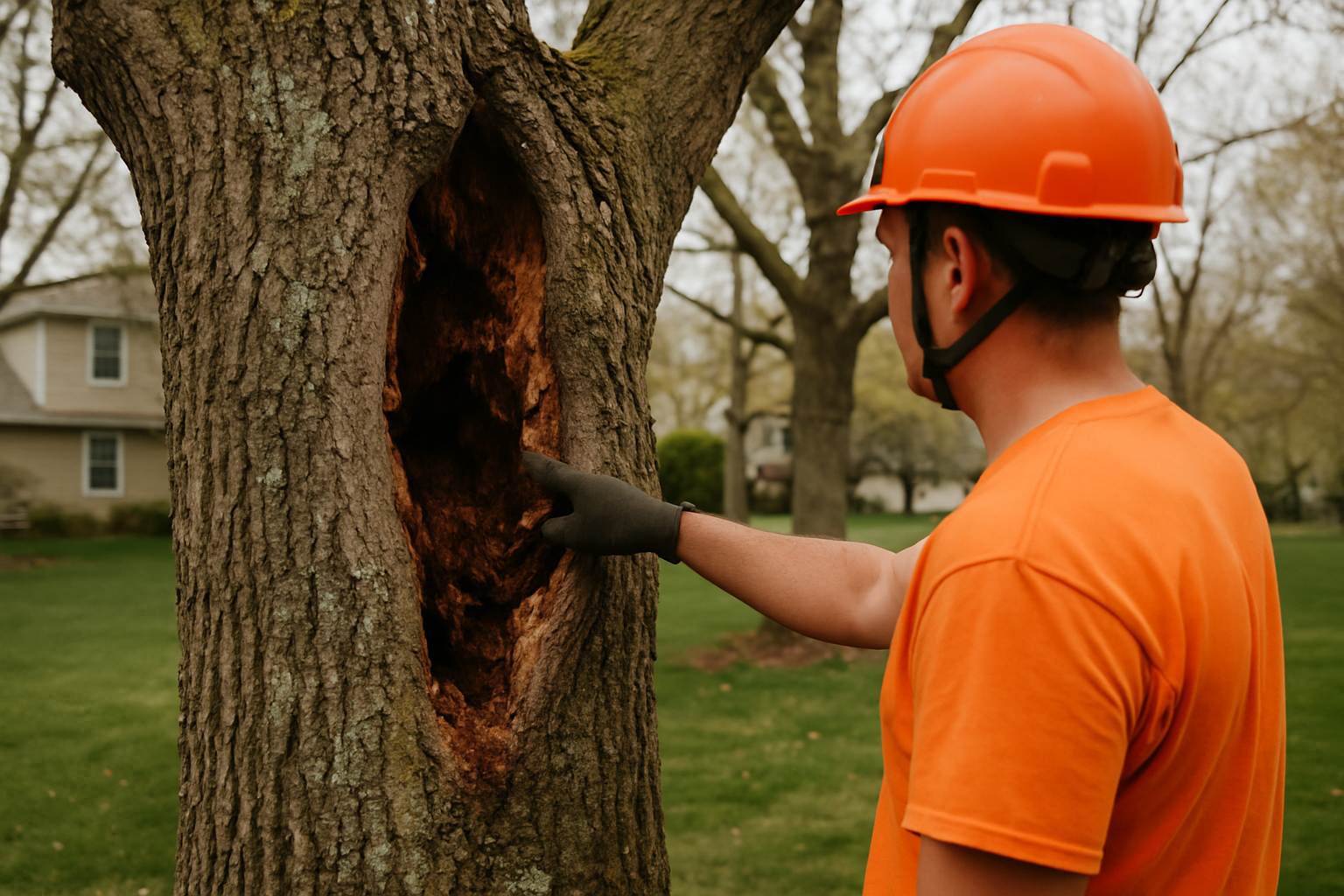
Surprisingly, yes. A tree can be hollow and remain stable if it has enough "residual wall thickness" - a thick ring of healthy wood on the outside. Arborists use the 30% rule. If more than one-third of the tree is hollow, the risk of a "silent collapse" skyrockets.
How to Spot Internal Tree Decay Before it Becomes Dangerous?
To accurately identify hidden risks, look for "fruiting bodies" growing directly on the trunk or root flare. These are the reproductive parts of the fungus living inside the wood.
Another red flag is "heaving" soil at the base. The roots lose their grip due to internal rot.
In addition, knowing how to spot internal tree decay before it becomes dangerous involves checking for cavities or "weeping" sap. This indicates that the tree is fighting an internal infection it might be losing.
Does Internal Decay Always Mean the Tree Must Be Cut Down?
Not necessarily. Many trees can be managed through weight reduction pruning or cabling. Removal is the only safe path if the decay is located at a critical structural union.
Go through our Grade-A Tree reviews. See how our professional assessments save trees that homeowners thought were lost causes.
Advanced Detection: When the Human Eye is not Enough?
Modern arboriculture has moved beyond simple visual checks. Professionals now use Sonic Tomography - sends sound waves through the trunk to map the density of the wood.
If the sound travels slowly, it indicates a hollow or decayed area. This high-tech "X-ray" for trees provides a 3D map of the interior without ever harming the bark.
How Often Should You Perform a "Self-Audit" on Your Landscape Trees?
You should walk your property at least twice a year:
- Once in full leaf
- Once when the branches are bare
This allows you to see the "skeleton" of the tree. Knowing how to spot internal tree decay before it becomes dangerous after a major weather event is also vital because a few urgent warning signs are:
- Fresh cracks
- New lean
Is Your Tree a Candidate for Removal?
If a tree shows significant canopy dieback combined with trunk cavities, it may pose an unacceptable risk. Grade-A Tree Care focuses on balancing the preservation of the urban canopy with the safety of the people living under it.
How to Maintain Structural Density of a Tree?
Prevention is the best medicine. Avoid:
- Wounding the trunk with lawnmowers
- Overly compacted soil
Healthy soil leads to healthy roots so the tree can compartmentalize decay before it spreads to the center.
The Bottom Line
Vigilance is the key to longevity. By learning how to spot internal tree decay before it becomes dangerous, protect both your investment and your safety. When in doubt, trust the science of modern diagnostics to give your trees the best chance at a long, sturdy life.
Professional Tree Care in Kansas City
Keep your trees healthy year-round with our Annual Tree Care Program. For $75/year, get expert inspections, pruning advice, and priority scheduling. Serving the Kansas City metro area.
Learn about the Annual Tree Care Program
0 Comments
Add a comment