
How to Save a Newly Planted Tree From Dying
by gradeatreeTree Care0 comments
Planting a tree carries a deep sense of hope. You have enriched your property and the environment. But that optimism fades quickly when the leaves begin to crisp, brown, or drop in the middle of summer. You are not dealing with a lost cause; you are likely dealing with a very predictable crisis. Understanding how to save a newly planted tree from dying simply requires correcting the balance between its damaged roots and its thirsty leaves before the stress becomes terminal.
Why Do Most New Trees Fail?
The problem starts underground before you even bring the tree home. During digging at the nursery, a tree loses over 95% of its water-absorbing roots. The tree you plant is essentially a survivor of minor surgery. It relies almost entirely on stored energy to heal.
A single hot day does not weaken the plant. Instead, it fails because it cannot physically drink water fast enough to replace what the sun evaporates.
Adding competition from dense turf grass or heavy clay soil slows root recovery further. It keeps the tree in an extended state of dehydration. The objective is not to fertilize your way out of this; the objective is to reduce the tree's atmospheric demand while aggressively protecting its moisture supply.
Signs Your Tree is Experiencing Transplant Shock
Observe the silent signals of a tree before its wood turns brittle. The most urgent red flag is leaf scorch - brown, crispy edges on leaves occur even when the soil feels wet. You may also observe:
- Early fall color in July or August
- Leaves wilting in the afternoon sun without recovering overnight
Crucially, a tree in shock fails to produce new twig growth. Know that the root system is stalled in the absence of:
- Buds swell in spring
- Tiny, pale leaves
Such above-ground patterns are direct indicators that the roots are not yet regenerating properly.
Can You Save a Dying Tree?
Unless the tree is already brittle and snapping, hope remains. Trees store significant emergency reserves in their trunk tissue. A tree is not always dying if:
- Its leaves are falling weekly
- It suffers dieback at the tips
In reality, such a tree saves its core structure by aborting parts where water supply is totally restricted. You can intervene successfully provided the cambium layer - the tissue just under the bark - is still green and moist. Scratch a small spot on a twig with your fingernail. Green means "wait and fight." Brown or grey usually means that section is dead. Patience is mandatory at this step. To fully resume normal growth patterns, a tree with a damaged root system may take one growing season per inch of trunk diameter.
How to Save a Newly Planted Tree From Dying?
Your rescue operation relies on a triage of deep watering, proper mulching, and resisting the urge to "feed" the patient.
Fixing the Watering Schedule
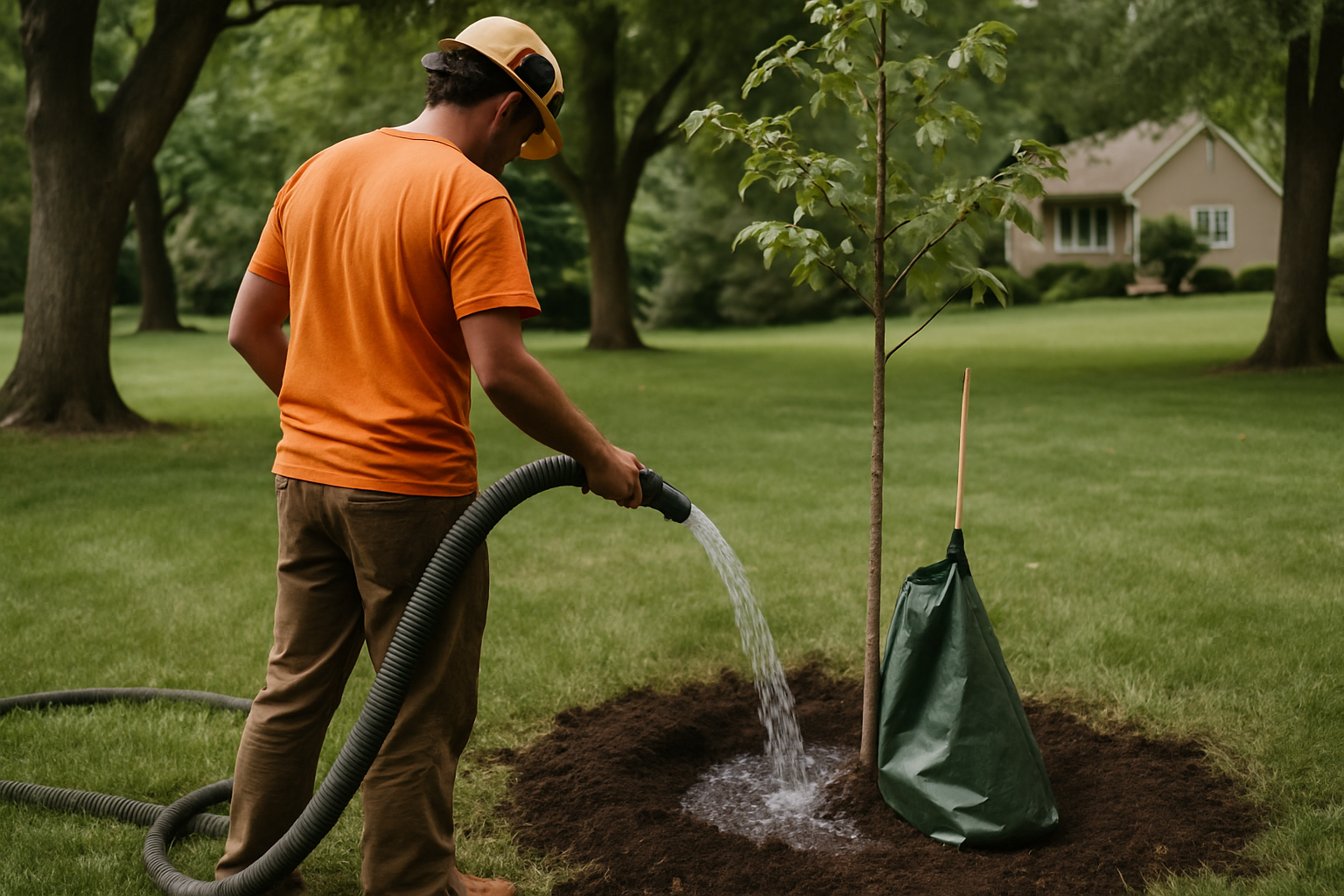
The number one killer is not a lack of water, but shallow sprinkles that never reach the root ball. Deep moisture is the only lifeline.
- Turn your hose to a slow trickle.
- During peak heat, place the hose directly on the root zone for 15 to 20 minutes, twice a week.
The goal is to soak the original root ball and the soil directly around it which forces the water past the surface. If you use a gator bag, keep it consistently filled every 5 to 7 days. Overwatering, however, drowning the roots in standing water, can be just as lethal as drought.
Pausing the Fertilizer
Oppose the mainstream urge to "boost" a sick tree with nitrogen. Root generation relies on stored carbohydrates inside the tree - not on a spike of soil nutrients. In a weak tree, fertilizer often forces top greenery growth that the dying roots cannot support, accelerating collapse. Your only soil additive might be a mild root stimulator, but standard lawn fertilizer must be kept far away from the root zone.
The Strategic Pruning Decision
You must remove only what is already dead, and nothing more. Every green leaf is a solar panel which produces energy to grow new roots. Prune the branch back to the branch collar if it is:
- Dry
- Hollow
- Snaps easily
Leave struggling but partially green leaves in place. The tree will naturally drop what it cannot feed, and those leaves are still critical to the recovery process.
Recovery Tactics for Struggling Roots
- Create a zone where roots face zero competition.
- Clear a ring of grass at least three feet wide around the trunk because turf roots aggressively steal moisture from young trees.
- Inside this ring, apply a "donut" of organic mulch - shredded bark or wood chips - three to four inches deep. This is absolutely critical: pull the mulch back six inches from the trunk flare.
- A "volcano" of mulch piled against the trunk traps moisture and heat which invites the following to slowly strangle your tree:
- Rot
- Insect invasion
- Girdling roots
If you live where winters are harsh, this insulation layer becomes even more essential. Provide dedicated, professional-level attention early to make the difference. This is why consulting Grade-A Tree Care helps you identify recovery potential you might miss.
Always check Grade-A Tree reviews to see how others in the community have saved their landscapes. For any deep-root feeding or structural pruning beyond your comfort zone, book tree care services in Kansas City ensures:
- Proximity
- Rapid emergency response
- Familiarity with regional clay-heavy soil conditions
The Bottom Line
Homeowners should know how to save a newly planted tree from dying. This is fundamentally about discipline and not magic. Most trees that die in the first year starve for water despite sitting in damp grass. Do not prune healthy tissue. Do not pour on chemicals. Never bury the trunk crown. Check the soil moisture with your finger. Keep the donut-shaped mulch layer distinct. Give the roots time to catch up. A tree in transplant shock can look terrible for an entire season while quietly rebuilding its foundation underground. Stay consistent. You will likely see the comeback unfold exactly one spring morning.
Professional Tree Care in Kansas City
Keep your trees healthy year-round with our Annual Tree Care Program. For $75/year, get expert inspections, pruning advice, and priority scheduling. Serving the Kansas City metro area.
Learn about the Annual Tree Care Program
0 Comments
Add a comment