
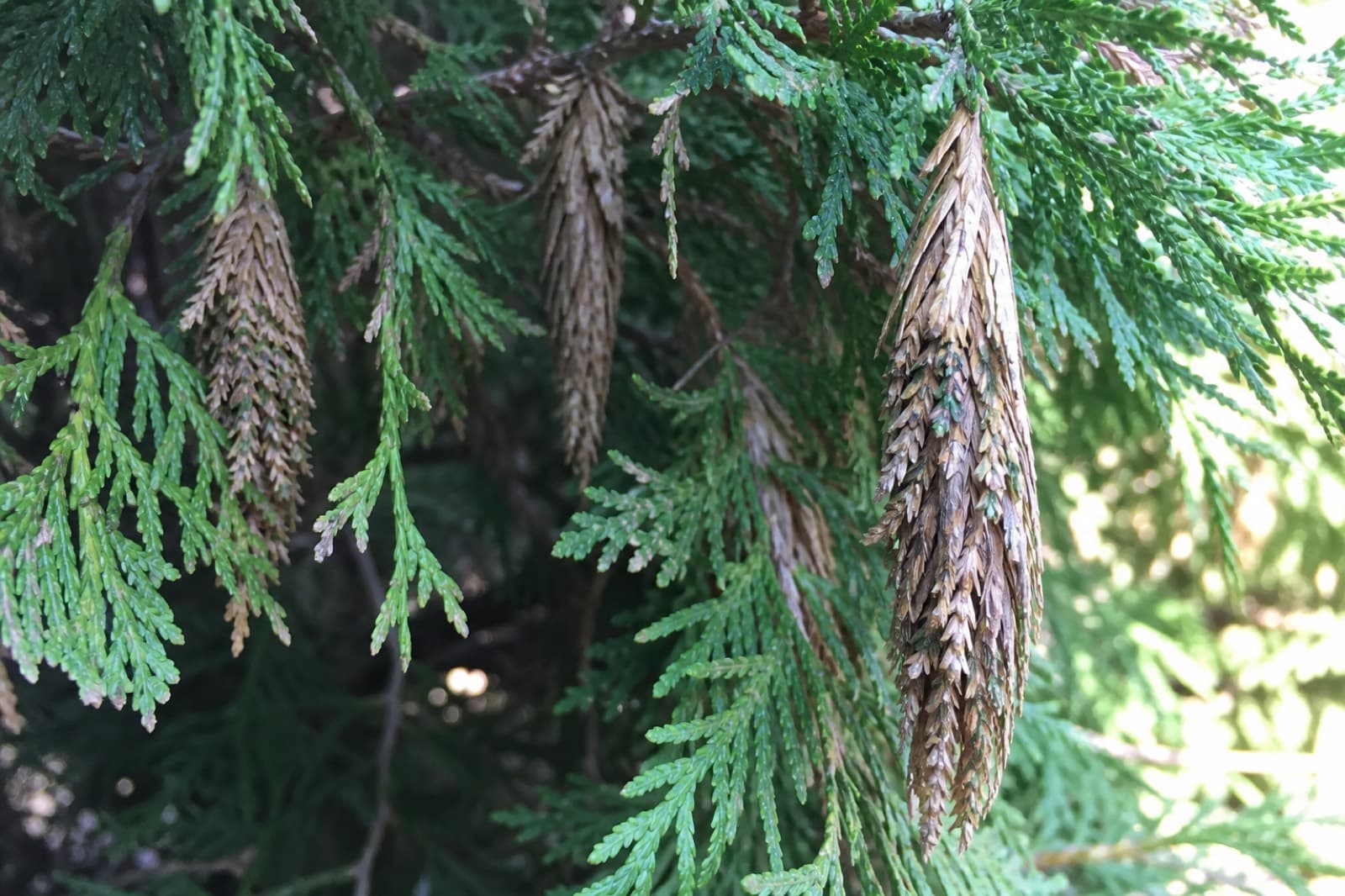
Kansas insect · Thyridopteryx ephemeraeformis
Bagworms in Kansas
K-State told Kansas homeowners in May 2026 to start scouting bagworms in early to mid-May. If you wait until the bags look like brown ornaments in August, the caterpillar has already sealed itself in and the chemical cannot reach it.
Field review: Jesse Swena, General Manager. Updated 2026-08-31.
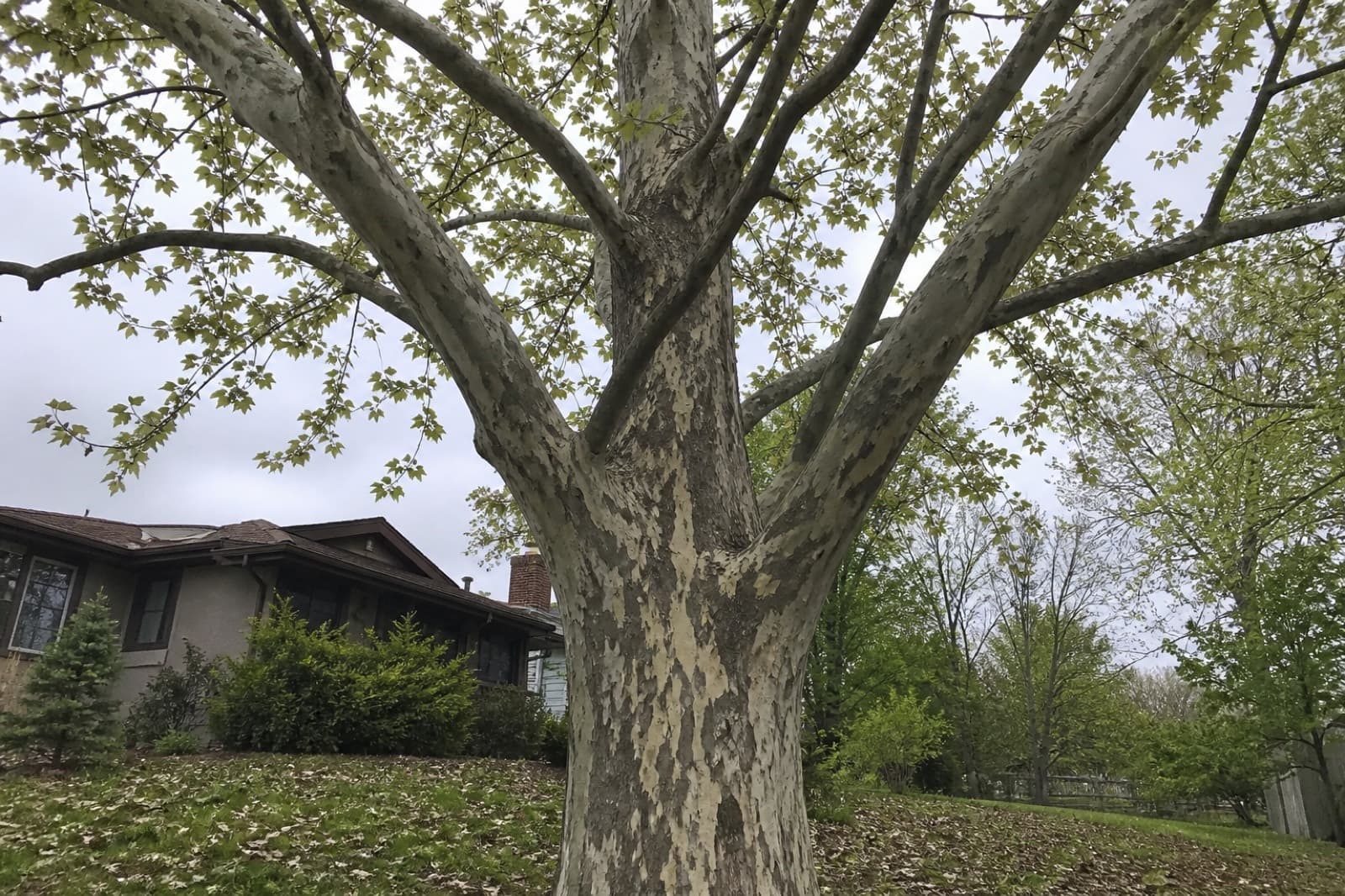
Bagworm is a native moth, Thyridopteryx ephemeraeformis. The damage is the larva. It builds a silk bag, sticks bits of the host plant on it, and walks that bag up an arborvitae, juniper, spruce, or eastern red cedar while it chews. Deciduous trees — maple, oak, honeylocust, sycamore — get hit too. They can leaf again. A defoliated arborvitae often cannot.
Raymond Cloyd at K-State and Shad Hufnagel at Kansas Forest Service have been repeating the same timing for years, including the May 2026 scouting note: eggs overwinter in the old female bags. Hatch runs mid-May through early June and stretches with the weather. Young bags are 1/8 to 1/4 inch. That is the window. They also balloon on silk, so your hedge can catch someone else’s hatch.
We spray a lot of these in Olathe, Shawnee, and south Kansas City because the homeowner finally saw the bags in July. By then you need thorough coverage and usually a second pass. A 20-foot red cedar windbreak is not a job for a pump sprayer from a garage shelf.
What to look for, month by month
- Winter and early spring: old gray-brown bags hanging like cones, full of eggs
- Mid-May to June: new bags the size of a grain of rice to a pea, easy to miss
- June and July: chewed, bronzed foliage starting at the top and outer tips
- August: bags anchored and sealed. Sprays stop working.
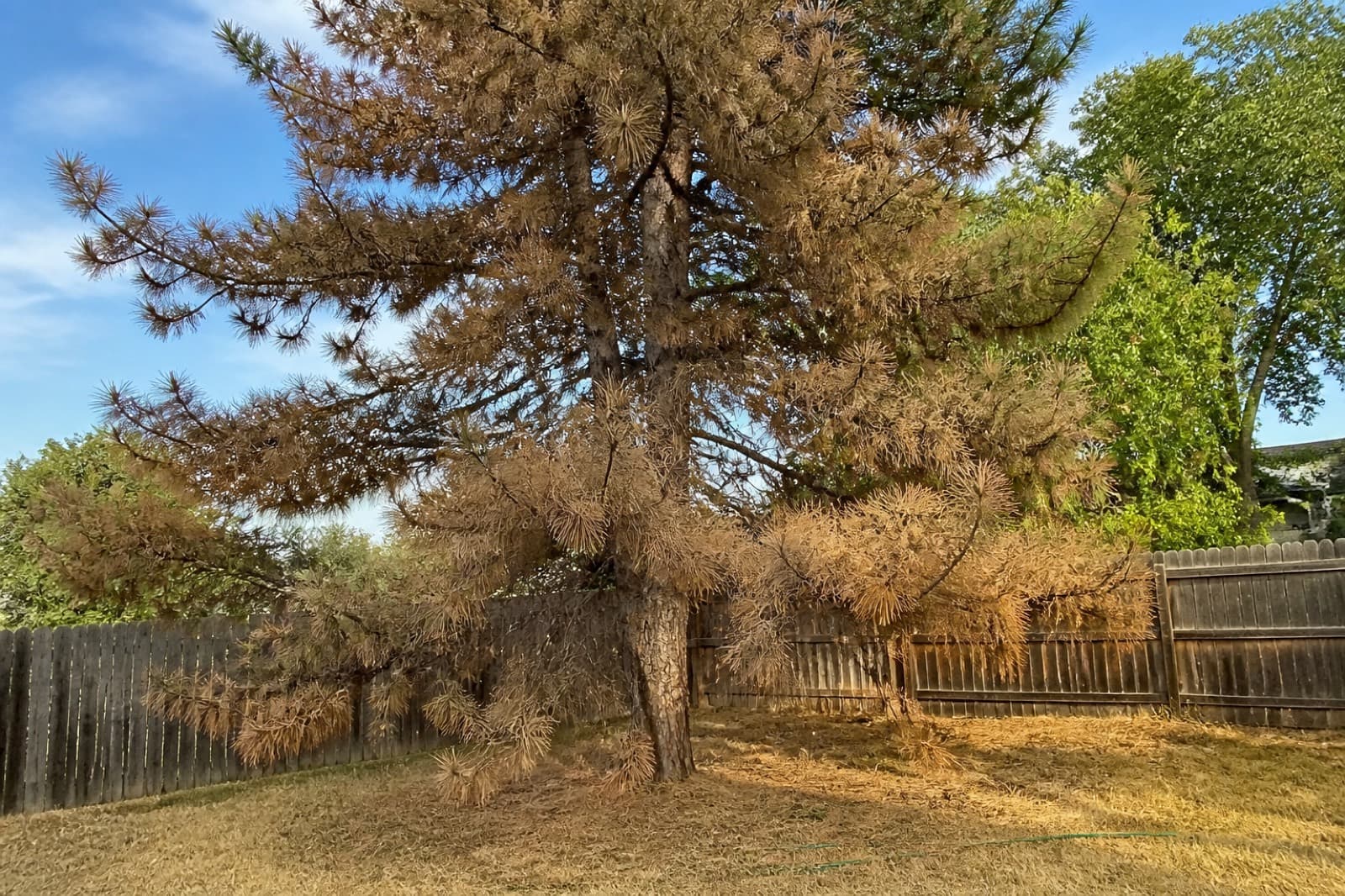
- Heavy years: whole sides of arborvitae or a cedar row turning brown
- After a kill: the evergreen stays brown. It does not push a second flush like a maple.
One late spray is how people waste July
If you only spray once, K-State’s older district advice was late June to early July, when most of the hatch is out and the bags are still thin. If last year was bad, they want two trips: late May or early June, then again three to four weeks later. The 2026 K-State note went further for some sites — weekly coverage for up to four weeks — because hatch is staggered.
Spinosad (the stuff in several homeowner bottles) works when the small caterpillar eats it. Bt works even earlier, on the smallest larvae. Once bags are an inch long and tough, people reach for broader insecticides and still miss the top of the plant. Bagworms start feeding high. Coverage that only wets the bottom four feet of an arborvitae screen is a gift to the insects.
- Hand-pick bags in winter and destroy them. Dropping them on the mulch does nothing.
- Scout at eye level and above, starting early May.
- Call us when the plant is taller than a ladder or it is a full windbreak. We use volume and pressure a hose-end bottle does not have.
Eastern red cedar rows are a Kansas specialty
K-State’s bagworm publication (MF3474) calls out long rows of Juniperus virginiana. That is half the rural and large-lot landscape between Grandview and Gardner. The upper and inner canopy never gets wet from the driveway. Jesse will not send a groundsman with a backpack into a 200-foot windbreak and call it treated.
Birds and parasitic wasps eat some bagworms. Not enough to save a hedge you already lost last year. If the plant is brown to the stem, we talk replacement, not a sympathy spray.
Kansas bagworm timing we work from
Dates follow K-State entomology (Cloyd), Kansas Forest Service (Hufnagel, May 2026), and MF3474.
| Overwinters as | Eggs inside last year’s female bags |
|---|---|
| Hatch | Mid-May through early June; cooler springs run late |
| Best spray size | Bags 1/8 to 1/4 inch |
| Single-spray compromise | Late June to early July |
| Two-spray program | Late May / early June, then 3–4 weeks later |
| Too late | Mid-August, once bags are anchored and sealed |
| Worst Kansas hosts | Arborvitae, juniper, eastern red cedar, spruce, pine |
Hedges and windbreaks we treat
Bagworms show up on a 4-foot foundation plant and on a quarter-mile cedar row. These are the cities where those calls cluster for us.
Map data © OpenStreetMap contributors.
Olathe
Arborvitae screens along new and older lots
38.8814, -94.8191
Shawnee
Juniper and cedar property-line hedges
39.0228, -94.7152
Lenexa
Foundation evergreens that get missed until July
38.9536, -94.7336
Grandview
Shop yard — we stage the high-pressure equipment here
38.8858, -94.5330
Raymore / Belton edge
Rural-lot red cedar rows
38.8017, -94.4527
Questions we get on this one
Spray will not punch through a sealed bag. Pick what you can reach and destroy the bags, or wait and treat the hatch next May. If the plant is already brown to the wood, budget a replacement.
They kill evergreens. A maple that gets chewed will usually leaf again. A 6-foot arborvitae that is stripped does not get a second flush. That is why we treat the conifers first.
A few bags on a waist-high shrub, yes. Hand-pick in winter. Scout in May. Spinosad on small larvae. Once the row is over your head, or last year was a blowout, you need coverage we can actually put in the top of the plant.
Sources
We used the records below instead of rewriting a national pest sheet. If a date or county count changes, this page should change with it.
- K-State Extension — “Now is the time to scout for bagworms,” May 2026
- K-State Extension Entomology — Bagworms (Cloyd, June 5, 2025)
- K-State MF3474 — Bagworm: insect pest of trees and shrubs (PDF)
- Kansas Department of Agriculture — plant protection and pest surveys
- Missouri Department of Agriculture — plant pests
Related Grade-A pages
Other library pages
Think this is in your yard?
Send a photo. Tell us the city and whether the tree sits over a house, a drive, or open lawn. We work out of Grandview and cover both sides of the state line.