
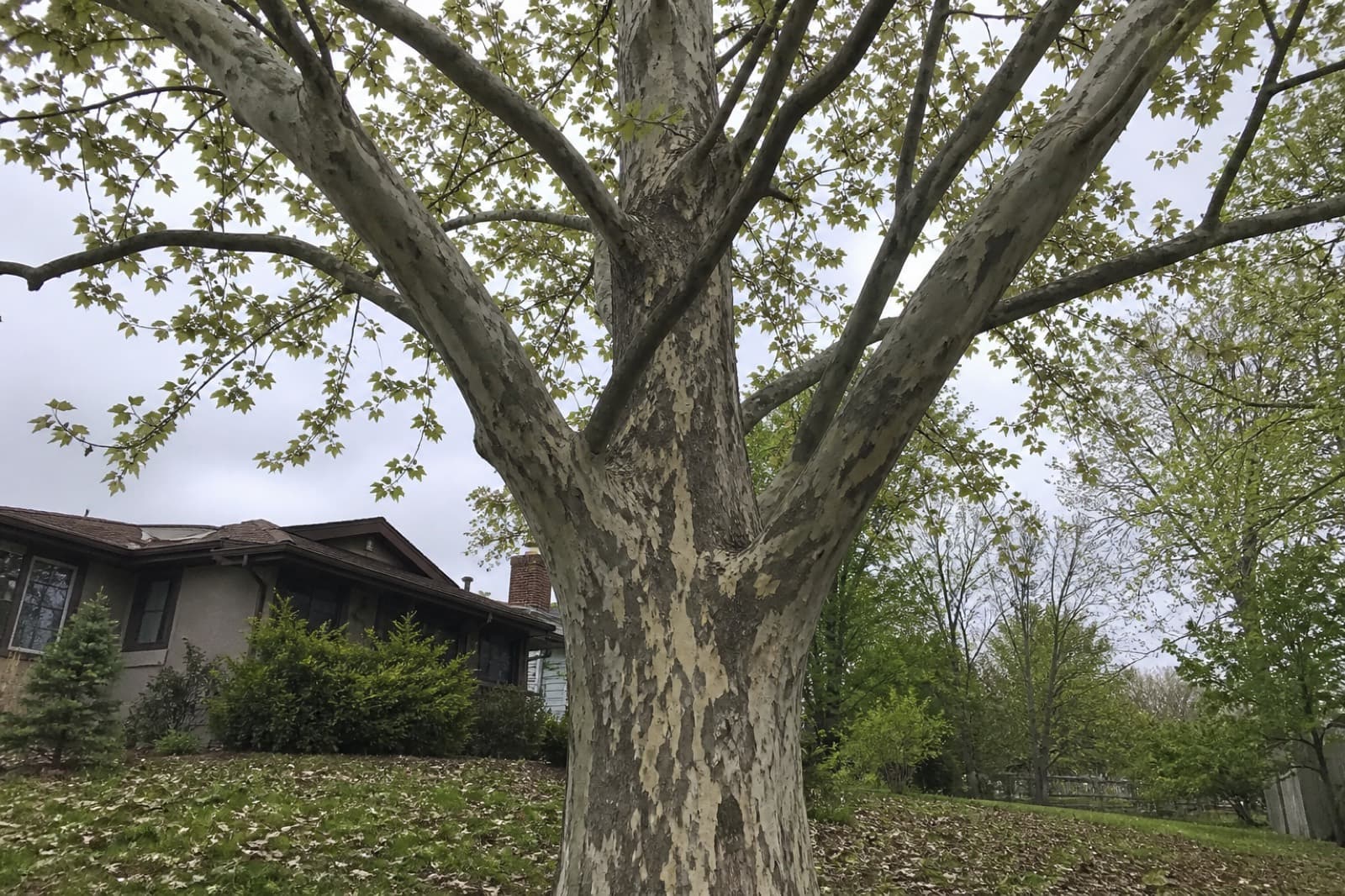
Kansas disease · Apiognomonia veneta
Sycamore anthracnose in Kansas
Every cool, wet May we get the same call: “The sycamore dropped everything. Should we take it down?” Most years the honest answer is no. K-State still calls sycamore anthracnose the most serious anthracnose in Kansas. Serious is not the same as fatal.
Field review: Jesse Swena, General Manager. Updated 2026-08-31.
The fungus is Apiognomonia veneta. It overwinters in last year’s twigs and in the leaf litter. In spring, when new shoots are out and the daily mean temperature sits around 50 to 55°F with rain on the leaves, it kills buds, young shoots, and expanding leaves. The tree can look frost-burned. Then the lawn fills up with half-grown sycamore leaves.
We wrote about this years ago in “Sick Sycamores.” The calls have not changed. They start late spring and they get louder if the tree stays thin into June. By early July, on a typical year, the same tree has a second set of leaves and the owner has forgotten they asked for a removal price.
London plane (Platanus × acerifolia) takes it better than American sycamore. We still see American sycamores along Brush Creek, in older Brookside-adjacent yards, and on big Independence and Kansas City, Kansas lots. Those trees can look wrecked in May and honest-to-goodness healthy in August.
Anthracnose, frost, or summer scorch
- Twigs and brand-new shoots die just as the tree tries to leaf out
- Young leaves crinkle, brown, and drop in a hurry
- On older leaves, tan or brown lesions run along the midrib and veins — not just the margin
- Small black fruiting bodies on killed one-year twigs
- After a few bad springs, the tree looks ragged, with witches’-broom clusters of shoots
- Summer scorch, which people confuse with this, burns the leaf edges in hot, dry July weather — different timing, different pattern
Why a removal quote in May is usually the wrong product
Missouri Botanical Garden and Morton Arboretum both describe the same cycle we see on the ground: cool wet spring, ugly tree, then a releaf once mean temperatures sit at 60°F or better. K-State says maple and ash anthracnose show up in Kansas too, but the sycamore strain is the one that makes people reach for the chainsaw.
Repeated years of it are not free. The tree spends energy pushing a second leaf crop. Twig dieback stacks up. Cankers can kill larger limbs. A sycamore that has done this five springs in a row may need deadwood taken out so those brittle twigs stop raining on the driveway. That is a prune, not a takedown.
What is worth doing on a Kansas City sycamore
Rake and get rid of the leaves. The fungus sits in that litter. Prune out obviously dead twigs once you can tell dead from late. Do it when the wood is dry enough to see. Water the tree in a dry winter or a hard July so it has something in the tank for the next spring.
Fungicide on a 70-foot sycamore is a big, expensive spray timed before infection, not after the lawn is already covered. We will talk about it on a high-value tree that sits over a patio and has lost the same limbs three years running. We will not sell a spray as a May rescue after the leaves are down. That ship has sailed.
- Wait through June before you decide the tree is dead
- Clean up leaves and killed twigs so next spring starts with fewer spores
- Ask us to deadwood the canopy if limbs are hanging over a target
- If you are planting new, consider London plane or a different genus entirely
Kansas anthracnose, without the brochure language
Host notes and the 50–55°F infection window come from K-State’s sycamore anthracnose sheet and from Missouri Botanical Garden’s disease page.
| K-State ranking | Most serious anthracnose disease in Kansas |
|---|---|
| Main host | American sycamore (Platanus occidentalis) |
| Tougher cousin | London plane — partially resistant, fewer cankers |
| Other Kansas hosts for anthracnose | Maple and ash more than elm or oak |
| Infection weather | Mean daily temps 50–55°F plus wet leaves at bud break |
| When the tree usually releafs | Once late-spring means hit about 60°F; often by early July |
| Fatal? | Rarely. Repeated years stress the tree and make a mess. |
Sycamores that generate the May phone calls
Big American sycamores sit on older lots and along creeks. These are the parts of the metro that fill Kim’s voicemail after a cold, wet April.
Map data © OpenStreetMap contributors.
Kansas City, MO
Older neighborhoods and creek corridors — classic May leaf drop
39.0997, -94.5786
Independence
Large-lot American sycamores
39.0911, -94.4155
Kansas City, KS
Wyandotte yards with 60-year sycamores
39.1141, -94.6275
Roeland Park / Mission
Tight lots, leaves all over the driveway
39.0244, -94.6472
Grandview shop
Where those “is it dead?” calls get scheduled
38.8858, -94.5330
Questions we get on this one
Usually not. Wait. If the twigs are still pliable and the tree pushes a second crop when the weather turns warm and dry, it was anthracnose. If the scaffold limbs are dry all the way back and there is no bud activity by mid-July, then we talk removal.
Only on a tree you have already decided is worth a preventive program, and only on a schedule that starts before infection. Spraying a defoliated tree in May does not put the leaves back. Sanitation and patience are the default.
Anthracnose is a group of fungi. Maples and ash get their own versions in Kansas. The sycamore fungus is the one that looks like the tree died overnight. The playbook — wet cool spring, ugly, then releaf — is similar.
Sources
We used the records below instead of rewriting a national pest sheet. If a date or county count changes, this page should change with it.
- K-State HNR — Sycamore anthracnose pest sheet (PDF)
- Missouri Botanical Garden — Sycamore anthracnose
- Morton Arboretum — Anthracnose of shade trees
- Grade-A Tree Care — Sick sycamores (older field article)
- Kansas Department of Agriculture — plant protection and pest surveys
- Missouri Department of Agriculture — plant pests
Related Grade-A pages
Other library pages
Think this is in your yard?
Send a photo. Tell us the city and whether the tree sits over a house, a drive, or open lawn. We work out of Grandview and cover both sides of the state line.