
Kansas disease · Bursaphelenchus xylophilus
Pine wilt in Kansas
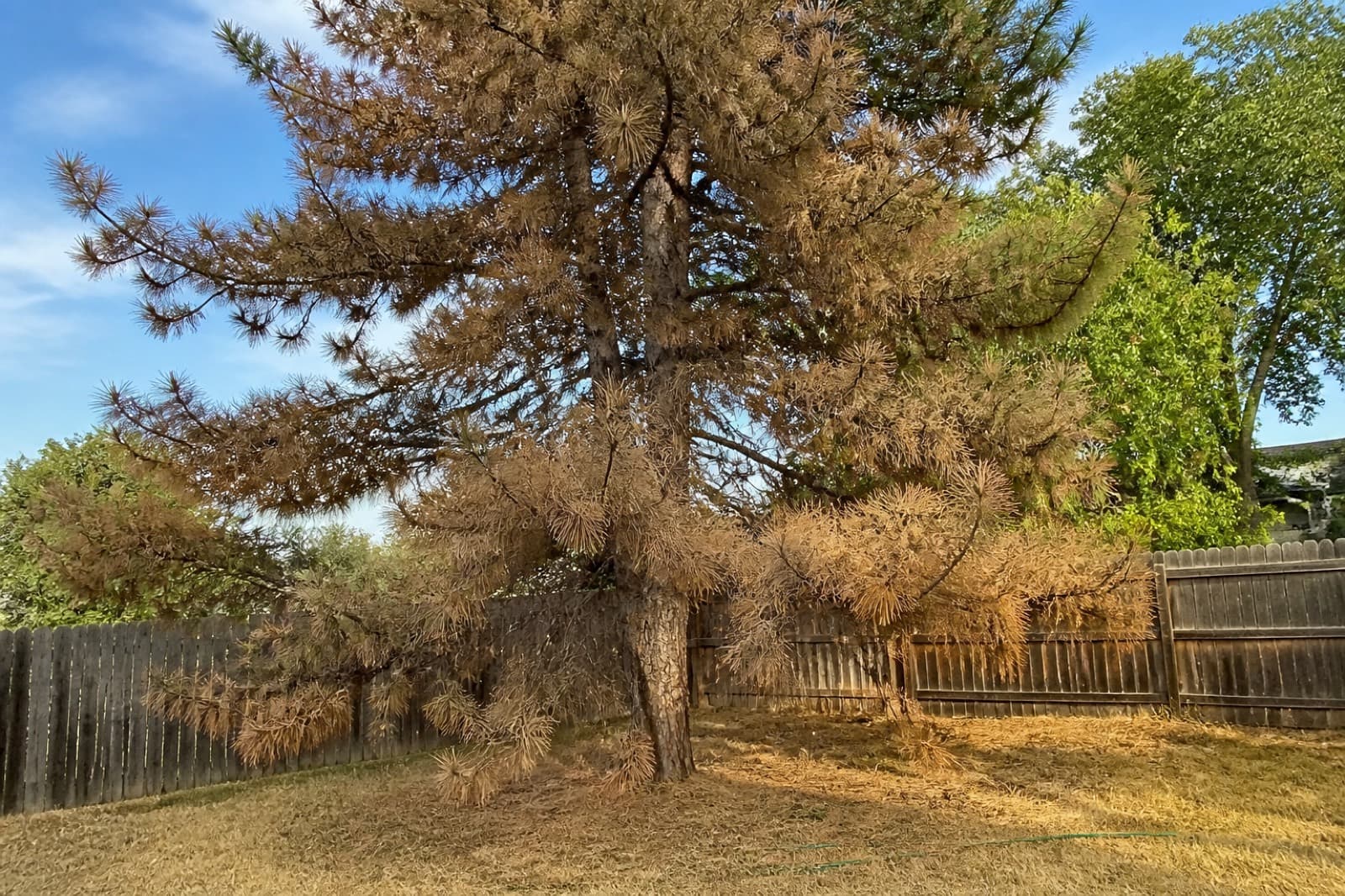
If a Scots pine in eastern Kansas goes from green to brown between August and Christmas, it is pine wilt until a lab says otherwise. K-State has been writing that sentence for decades. We have been cutting the trees.
Field review: Phil Giordano, Consultant. Updated 2026-08-31.
Pine wilt is a nematode disease, not a beetle hole you can spray. The pinewood nematode, Bursaphelenchus xylophilus, rides inside pine sawyer beetles (Monochamus). The beetles emerge around May 1, carry nematodes to a new pine, and the worm multiplies in the resin canals. Resin flow stops. The tree wilts. Needles hang on, dead, for up to a year.
The first U.S. confirmation was Columbia, Missouri, in 1979. Southeast Kansas showed up the same year. Forty-plus years later, K-State’s John C. Pair Horticultural Center is still breeding for resistance, and their county agents are still telling people not to plant Scots or Austrian pine in the eastern two-thirds of the state.
We see it in older windbreaks and in the “privacy pine” rows people put in during the 1990s — Olathe, Gardner-adjacent lots, south Overland Park, and the Missouri side around Grandview and Belton. A healthy-looking Austrian pine in June can be a brown flagpole by October.
Pine wilt vs. the other Kansas pine problems
- Needles fade gray-green, then yellow, then brown — sometimes one limb, often the whole tree
- The brown needles stay attached instead of shedding cleanly
- A fresh cut or wound stays dry. Healthy pine bleeds sticky resin.
- The whole tree is dead in weeks to a few months, not over three summers
- Tip blight, by contrast, kills branch tips slowly and leaves the rest of the tree alive
- Dothistroma needle blight browns needles from the bottom up and rarely kills the tree in one season
The May 1 deadline is not a suggestion
Sawyer beetles and nematodes overwinter in the dead tree. They start crawling out around May 1. K-State’s standing advice, repeated again in county columns in 2025, is to have a positive or obviously dead pine on the ground before that — April 1 is better. Cut it to the soil line. Do not leave a tall stump. Chip or burn the wood. Do not stack it behind the shed as next year’s kindling.
Megan Kennelly, K-State plant pathology, has been blunt about this for years: if the pine is already dead in the eastern two-thirds of Kansas, treat it as pine wilt and get it out. You can still send a 2-inch-thick branch, cut against the trunk, to the K-State diagnostic lab if you want the piece of paper.
There is no curative spray. We will not sell you one.
Preventative trunk injections exist. They have to go in before the nematode does, they are not 100 percent, and they are a professional job. Once needles are brown, the conversation is removal and what to plant that can actually live here — eastern red cedar is overused, but Norway spruce, Bald cypress, and several oaks beat another Scots pine.
Phil’s rule on these is the same as K-State’s: do not plant Scots or Austrian pine in eastern Kansas right now. The Pair Center work may give us better evergreens later. It has not given us a reason to keep selling the two species that keep dying.
- Sample: 2 inches thick, 6–8 inches long, from against the trunk, late summer or early fall
- Removal window: as soon as it is dead, and before May 1
- Disposal: chip or burn. No firewood. No “I’ll deal with the stump in June.”
Kansas pine wilt, the parts that matter on a lot
Host range and dates come from K-State publication L-722 and the HNR pest sheet last updated November 13, 2023.
| First U.S. find | Columbia, MO, 1979 — SE Kansas the same year |
|---|---|
| Worst host in Kansas | Scots pine (Pinus sylvestris) |
| Also hit | Austrian pine; white pine less often |
| Where it is common | Eastern two-thirds of Kansas |
| When new kills show | August through December |
| Beetle emergence | Around May 1 |
| K-State stance on planting | Do not plant Scots or Austrian pine in Kansas right now |
Where we cut dead pines in the metro
Pine wilt is a rural windbreak story and a suburban screen story. These pins are the cities where we keep taking brown Scots and Austrian pines out of back yards.
Map data © OpenStreetMap contributors.
Olathe
1990s pine screens and older windbreaks
38.8814, -94.8191
Overland Park (south)
Austrian pine rows along property lines
38.8500, -94.6700
Grandview shop
We chip on site or haul. No “leave it for firewood.”
38.8858, -94.5330
Belton
South-metro lots with dying privacy pines
38.8119, -94.5319
Lee’s Summit
Older subdivisions with mixed pine screens
38.9108, -94.3822
Questions we get on this one
Not from pine wilt. The needles hanging on a gray tree in January are last summer’s death, not a winter nap. If you want the lab to say it, we can cut a sample. Either way the tree should be down before the beetles fly in May.
No. Bark beetles are insects that mine the cambium. Pine wilt is a nematode hitchhiking in a sawyer beetle. The field tell is speed plus dry, resin-poor wood. We still send odd ones to K-State when the pattern is not clean.
Stop defaulting to Scots and Austrian pine. Talk to us or to Johnson County Extension before you buy a 10-foot screen. Bald cypress, certain spruces, and a mixed deciduous hedge survive our summers more often than another Pinus nigra.
Sources
We used the records below instead of rewriting a national pest sheet. If a date or county count changes, this page should change with it.
- K-State — Pine wilt (Butler County horticulture article)
- K-State Research and Extension L-722 — Pine diseases in Kansas (PDF)
- K-State HNR — Pine wilt pest sheet (updated Nov. 13, 2023)
- K-State Turf Blog — “Cut and destroy those pine wilt infected trees ASAP”
- Kansas Department of Agriculture — plant protection and pest surveys
- Missouri Department of Agriculture — plant pests
Related Grade-A pages
Other library pages
Think this is in your yard?
Send a photo. Tell us the city and whether the tree sits over a house, a drive, or open lawn. We work out of Grandview and cover both sides of the state line.