
Kansas insect · Agrilus planipennis
Emerald ash borer in Kansas
Kansas confirmed emerald ash borer in Wyandotte County in 2012. As of October 31, 2025, the Kansas Forest Service is at 19 counties. If you still have a green or white ash in Johnson, Wyandotte, or Leavenworth County, the beetle is not a future problem. It is already in the woodpile.
Field review: Phil Giordano, Consultant. Updated 2026-08-31.
We still get calls from Overland Park and Shawnee that start the same way: the canopy thinned last summer, a ring of sprouts showed up on the trunk, and now someone noticed little D-shaped holes. That is EAB. The adult beetle is a small metallic-green buprestid. The damage is the larva chewing S-shaped galleries under the bark until the tree cannot move water.
Kansas Forest Service forest health coordinator Shad Hufnagel put the current count on the record on October 31, 2025, after a live larva turned up in a trap tree north of Marysville in Marshall County. That was the fourth new Kansas county in 2025, after Linn, Pottawatomie, and Bourbon. The state estimates about 65 million ash trees. Most of them sit on private land.
Grade-A Tree Care works the metro end of that map — Wyandotte (2012), Johnson (2013), Leavenworth (2014), Miami (2019). We inject ash that still has enough canopy to be worth saving. We take down the ones that have already become a driveway problem. Phil Giordano has been watching this wave since the first Wyandotte find.
What EAB looks like on a Kansas City ash
- Canopy starts thinning from the top, often over two or three summers
- Epicormic sprouts (water sprouts) along the trunk or lower limbs
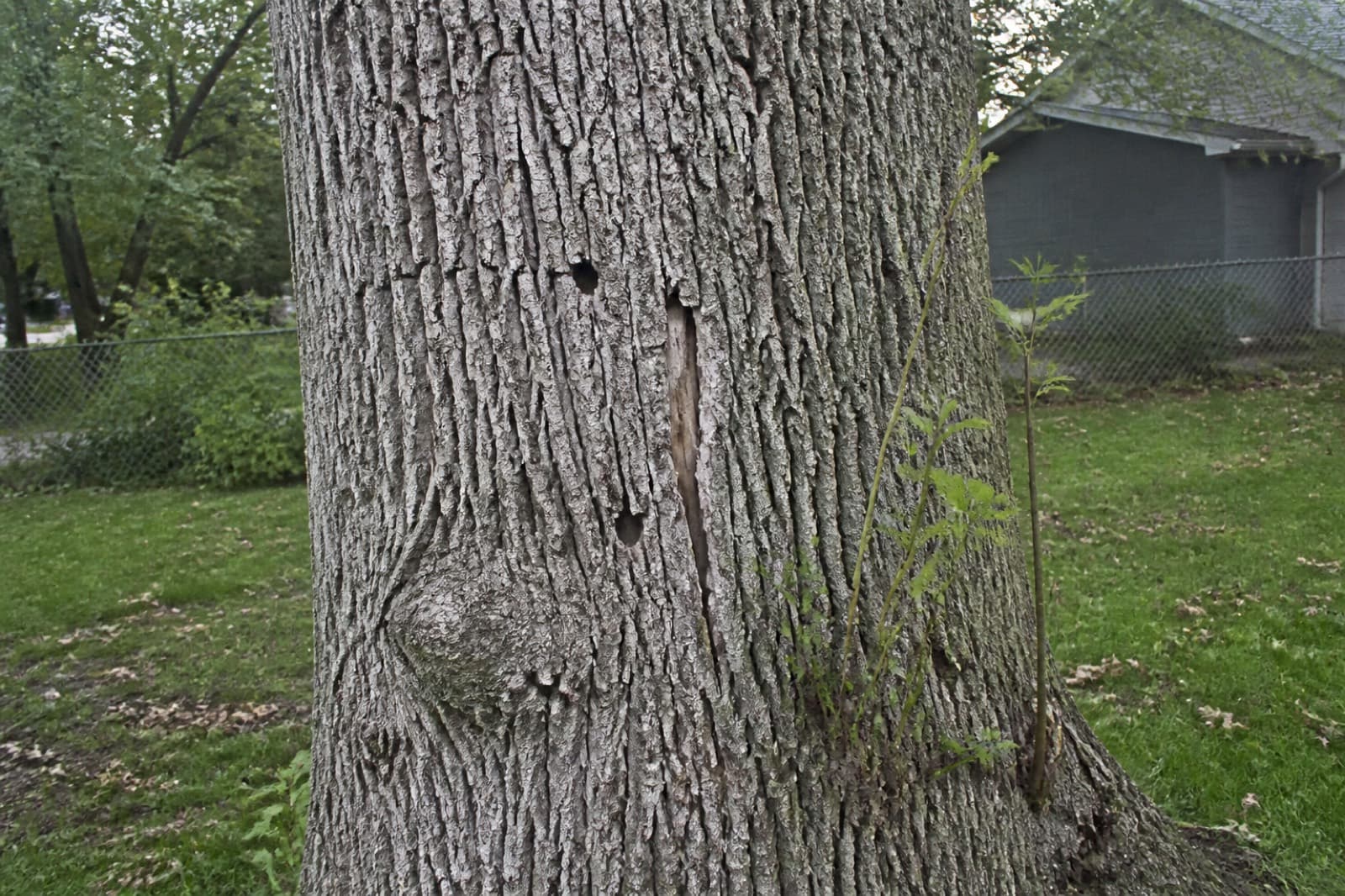
- Vertical bark splits that show tan, S-shaped larval galleries underneath
- Small D-shaped exit holes, about 1/8 inch, on the trunk and large limbs
- Woodpecker flecking — birds peeling bark to get at larvae
- Dead scaffold limbs over a roof, drive, or play set
Treat it, or take it down
Systemic insecticides can keep a still-healthy ash alive. Missouri’s EAB management guide and K-State’s field advice both say the same thing we tell customers: treat before the canopy is shot. Once more than about half the crown is gone, you are paying to delay a removal.
The products that actually move in a tree are applied as a trunk injection, a soil drench, or a basal bark spray. Emamectin benzoate injections are the ones we use on specimen trees we intend to keep for years. Soil products (imidacloprid, dinotefuran) are cheaper and need more frequent return trips. Drought-stressed trees on Johnson County clay do not take soil drenches well unless we water the root zone first.
If the ash is already shedding large limbs, or it sits over a house in Leawood or a storefront in Mission, we price a removal. Dead ash gets brittle faster than people expect. That is how you get a trunk that hinges through a garage door in a July thunderstorm.
- Candidate for treatment: more than half the canopy still leafed out, no major dead leaders over a target
- Candidate for removal: top-down dieback, bark coming off in plates, or the tree already dropped wood
- Do not move the firewood. Human-moved ash is how Marshall County likely got its 2025 find.
Why “my neighbor’s ash looks fine” is a bad plan
Adult beetles do not fly far on their own. They ride firewood, brush piles, and nursery stock. Once a neighborhood has one infested street tree, the rest of the block is on a clock. Overland Park, Prairie Village, and Leawood already spent years and city budgets taking ash out of rights-of-way. Private yards are catching up.
If you are replacing an ash, do not plant another ash. Kansas Forest Service keeps a recommended-tree list for a reason. We would rather put a bur oak, a Kentucky coffeetree, or a bald cypress in that hole than sell you a second round of injections in 12 years.
Kansas EAB confirmations we actually cite
County list and years come from the Kansas Forest Service / K-State Extension release dated October 31, 2025. Marshall County made 19.
| Wyandotte County | 2012 — first Kansas find |
|---|---|
| Johnson County | 2013 |
| Leavenworth County | 2014 |
| Douglas County | 2015 |
| Jefferson County | 2015 |
| Atchison County | 2016 |
| Doniphan County | 2017 |
| Shawnee County | 2017 |
| Miami County | 2019 |
| Jackson County, KS | 2019 |
| Brown County | 2022 |
| Osage County | 2022 |
| Franklin County | 2023 |
| Lyon County | 2024 |
| Nemaha County | 2024 |
| Linn County | 2025 |
| Pottawatomie County | 2025 |
| Bourbon County | 2025 |
| Marshall County | October 31, 2025 — 19th county |
Metro ash we still get called about
These are yards and lots we actually service, not a national heat map. The pin in Grandview is the shop. The rest are cities where untreated ash is still standing.
Map data © OpenStreetMap contributors.
Grade-A Tree Care shop
3400 Robinson Pike Rd, Grandview, MO
38.8858, -94.5330
Kansas City, KS (Wyandotte)
First Kansas confirmation, 2012
39.1141, -94.6275
Overland Park
Johnson County confirmed 2013; many street ashes already gone
38.9822, -94.6708
Shawnee
Private-yard ash still common on older lots
39.0228, -94.7152
Leavenworth
County confirmed 2014
39.3111, -94.9225
Olathe
Southern Johnson County yards and windbreaks
38.8814, -94.8191
Questions we get on this one
If more than half the canopy is still alive and the trunk has not started shedding plates of bark, a trunk injection can keep it going. We will tell you if the tree has already crossed into removal. Treating a skeleton is a waste of money.
EAB exit holes are D-shaped and small, about the size of a pencil eraser. Round holes are usually something else. The more reliable signs in this metro are top-down dieback plus S-shaped galleries under split bark. If you want a lab ID, we can get a sample toward the Kansas Department of Agriculture or Kansas Forest Service, especially outside the already-confirmed counties.
Kansas does not need a quarantine poster on your garage to make this a bad idea. The 2025 Marshall County find sat next to a city brush dump. Leave dead ash on the property, chip it, or have us haul it. Do not drive it to a cabin in a county that has not confirmed EAB yet.
Anything but another ash. We use the Kansas Forest Service recommended-tree list and match the hole: bur oak or chinkapin oak on a wide lot, Kentucky coffeetree or thornless honeylocust on a parking strip, bald cypress where the soil stays wet.
Sources
We used the records below instead of rewriting a national pest sheet. If a date or county count changes, this page should change with it.
Related Grade-A pages
Other library pages
Think this is in your yard?
Send a photo. Tell us the city and whether the tree sits over a house, a drive, or open lawn. We work out of Grandview and cover both sides of the state line.