
Kansas disease · Bretziella fagacearum
Oak wilt in Kansas
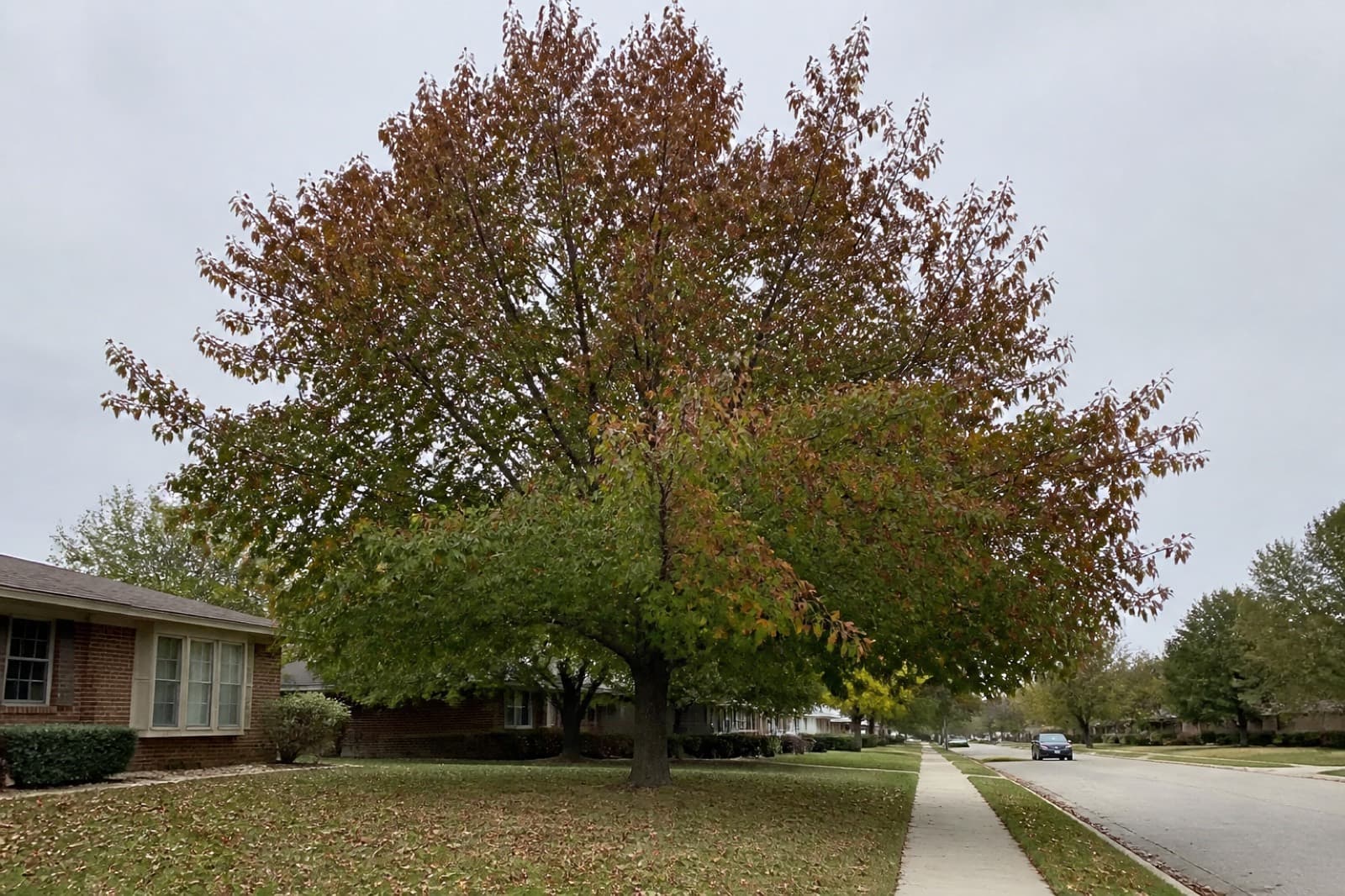
Overland Park confirmed at least three oak wilt cases in September 2025. Two of them were at the Indian Creek Recreation Center. Pin oak is still the city’s official tree. That is a bad combination.
Field review: Jesse Swena, General Manager. Updated 2026-08-31.
Oak wilt is a vascular fungus, Bretziella fagacearum (you will also see the older name Ceratocystis fagacearum). It tricks the tree into plugging its own water pipes. On red oaks and pin oaks, that can finish a tree in a year. Sometimes faster. White oaks hang on longer and still lose.
This is not a national brochure disease we pasted onto Kansas. Johnson County Post reported on October 22, 2025 that Overland Park, Prairie Village, Mission Hills, and Leawood have all had cases in recent years. Prairie Village’s city arborist, Bridget Tolle, said her city did not have a confirmed case yet in 2025 as of late September, but it has had multiple-case years. Olathe forester Mike Katzer’s line was the one we already use on estimates: once oak wilt is in a tight stand of oaks, it can walk the block through the roots.
K-State’s diagnostic lab has been pulling oak wilt out of Johnson County red oaks for years. Their 2019 turf and landscape note called it an occasional problem on red and pin oak in northeast Kansas and the Missouri-line counties. Occasional is not the same as gone.
How it shows up on a Johnson County oak
- Upper canopy turns and drops in mid-summer, not in October
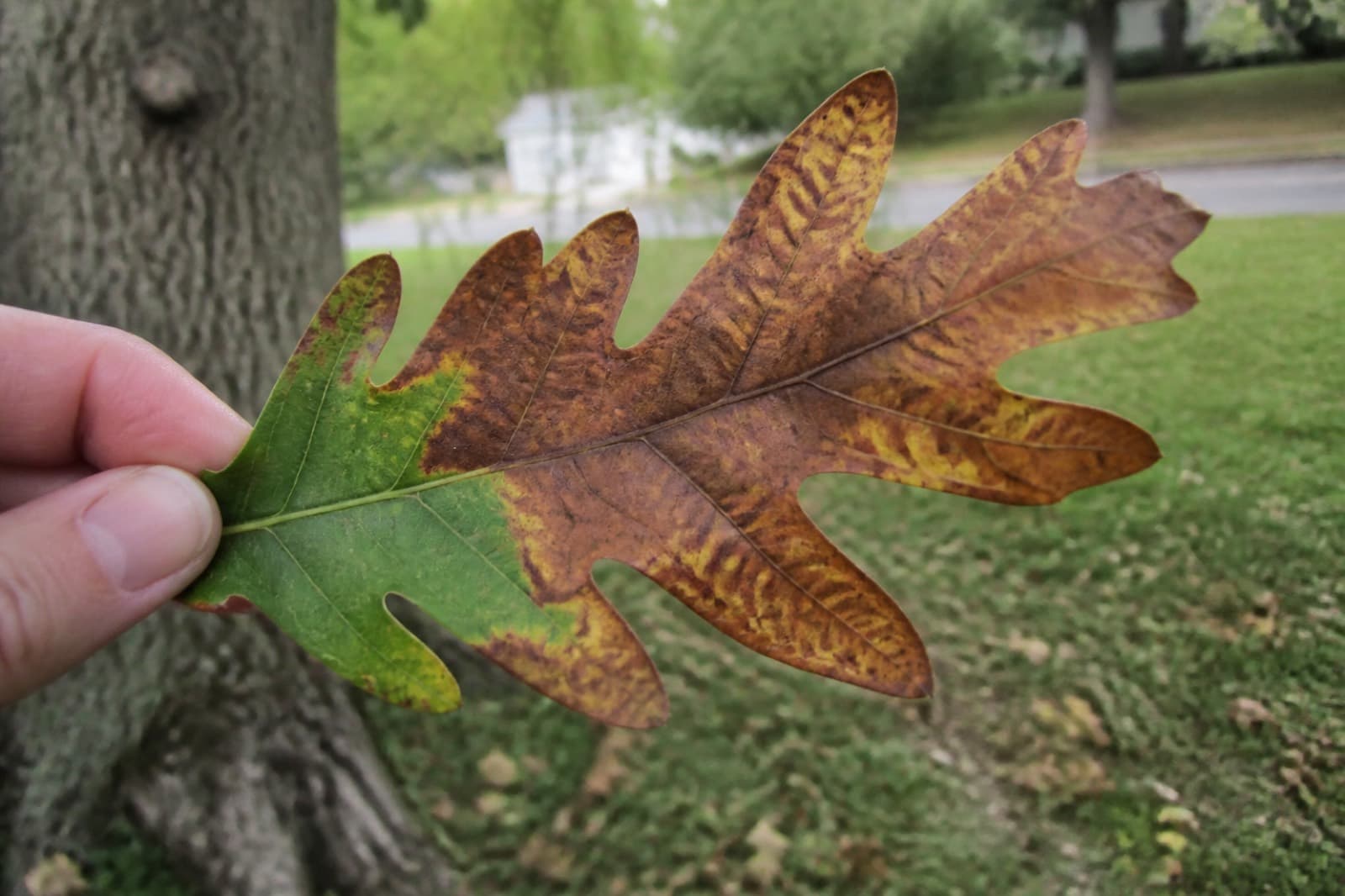
- Leaves brown from the tip and edge, often with a green wedge left at the base
- A whole leader or one side of the tree goes first, then the rest follows
- On red oaks, the decline can run in weeks, not seasons
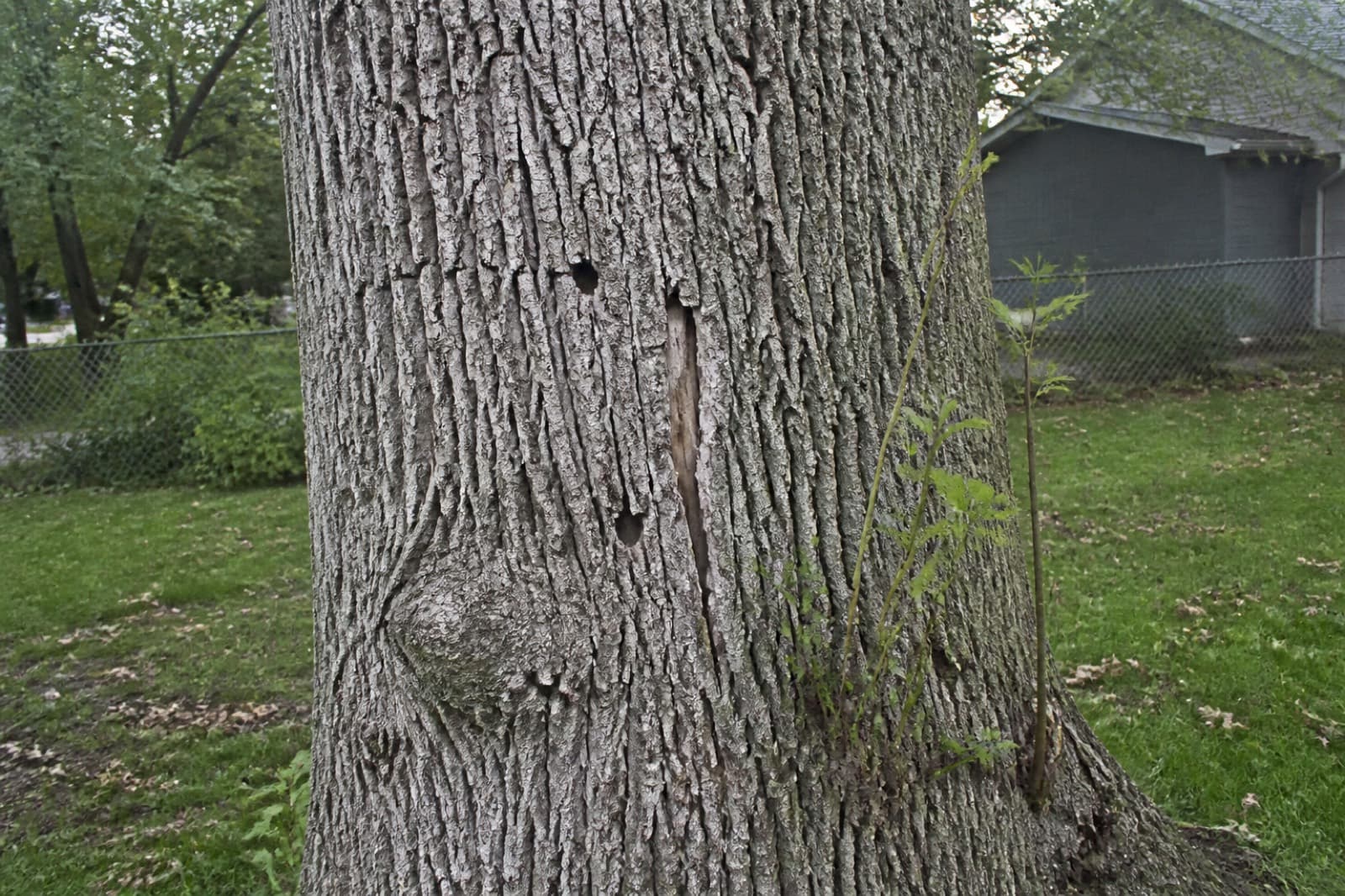
- Peel the bark on a wilting limb and you may see brown streaking in the sapwood
- Advanced cases can push a fungal mat under the bark with a sweet, fruity smell
Stop pruning oaks in the growing season
Nitidulid beetles — sap beetles — carry spores from a fungal mat to a fresh wound. They are active while oaks are growing. That is why city foresters in Overland Park and Prairie Village tell residents the same thing we do: do not prune an oak from April through October if you can help it.
Winter is the window. The beetles are quiet, the tree can start closing the cut, and you are not opening a door on a 60-year-old pin oak because a branch brushed a gutter. If a storm rips a limb in June, we clean the break. That is different from a cosmetic raise we can schedule in January.
The underground problem: root grafts
Oaks of the same group growing 50 to 75 feet apart often share root connections. The fungus uses those like a hallway. One infected red oak on a Prairie Village cul-de-sac can take the next three. That is why a confirmed tree is not just a removal. It is a conversation about the oaks on either side, and sometimes about a trench to break the graft.
Overland Park city forester Bailey Patterson said the quiet yard with a single oak is a different case. If nothing else of the same type is nearby, the disease can die with that tree. We still want it confirmed, cut, and the wood off the lot. Do not stack it for next winter’s fire pit.
- Red oak group (pin, red, black, Shumard): treat as an emergency if wilt starts at the top
- White oak group: slower, still not something we “watch for a year” without a plan
- Lab confirmation: K-State Plant Disease Diagnostic Lab. Missouri residents can use MU Extension’s free oak testing program with MDC.
What we can actually do
There is no spray that pulls oak wilt out of a symptomatic red oak. Propiconazole trunk injections are a preventative for the healthy oaks standing next to a confirmed tree. Leawood’s parks superintendent, Dustin Branick, has said those injections are intensive and only make sense when the fungus is already on the block.
Our job on a suspect tree is to take a proper sample — live but wilting wood, not a handful of brown leaves from the lawn — and get it toward K-State or, on the Missouri side, MU. If it comes back positive, we schedule the takedown, grind or treat the stump so it does not keep the fungus sitting there, and look at the neighbors.
Johnson County oak wilt, on the record
City-level notes below come from the Johnson County Post story of October 22, 2025, plus K-State’s earlier Johnson County lab recoveries.
| Overland Park | At least 3 confirmed cases in September 2025; 2 at Indian Creek Recreation Center |
|---|---|
| Leawood | Cases in recent years; city discusses preventative injections only after a nearby confirm |
| Prairie Village | No 2025 confirm as of late September; multiple-case years in the recent past |
| Mission Hills | Cases in recent years |
| Olathe | City forestry watching spread through oak stands |
| K-State lab | Oak wilt recovered from Johnson County red oaks; NE Kansas and Missouri-line counties |
| Pruning window | Avoid April–October. Winter cuts only unless a storm forces a cleanup. |
Oaks we worry about first
Pin oak streets in northern Johnson County are the stands that keep city foresters up at night. We marked the shop and the cities named in the 2025 reporting.
Map data © OpenStreetMap contributors.
Indian Creek Recreation Center
Two of Overland Park’s September 2025 confirms
38.9510, -94.6640
Prairie Village
City arborist Bridget Tolle — multiple-case years
38.9917, -94.6336
Leawood
Parks staff will inject neighbors after a confirm, not as a blanket program
38.9667, -94.6169
Mission Hills
Recent oak wilt cases on private lots
39.0139, -94.6169
Olathe Forestry
Mike Katzer: spread risk inside a big oak population
38.8814, -94.8191
Grade-A Tree Care shop
Grandview — we sample and remove on both sides of the state line
38.8858, -94.5330
Questions we get on this one
Scorch and bacterial leaf scorch usually start at the edges and crawl over years. Oak wilt on a red or pin oak is sudden, often from the top, and the tree looks worse every week. We will not guess on the internet. We take wood and send it to a lab.
Not if you can wait. April through October is when sap beetles move spores into fresh cuts. If ice or wind already tore a limb, call us and we will make a clean cut. That is damage control, not a raise-and-thin we can do in January.
No. Once a red oak is symptomatic, the honest job is confirmation, removal, and protecting the oaks next to it. Injections are for the still-green neighbors.
Kansas samples go to the K-State Plant Disease Diagnostic Lab, often through Johnson County Extension. Missouri residents can start with photos at the University of Missouri Plant Diagnostic Clinic; MDC has been funding free oak-disease testing.
Sources
We used the records below instead of rewriting a national pest sheet. If a date or county count changes, this page should change with it.
- Johnson County Post — “Local foresters warn oak wilt could threaten trees around JoCo,” Oct. 22, 2025
- K-State Turf and Landscape Blog — oak wilt recovered from Johnson County red oaks (2019)
- University of Missouri Extension / MDC — free oak disease testing, 2025
- Kansas Department of Agriculture — plant protection and pest surveys
- Missouri Department of Agriculture — plant pests
Related Grade-A pages
Other library pages
Think this is in your yard?
Send a photo. Tell us the city and whether the tree sits over a house, a drive, or open lawn. We work out of Grandview and cover both sides of the state line.